

What Is an Insider Threat?
The insider threat definition refers to a security risk originating from individuals within an organization: people who have legitimate access to critical systems and data. These may be employees, former staff, contractors, or third-party vendors.
Insider threats can take several forms:
Malicious Insider Threats: Employees or other authorized individuals deliberately misuse their access rights to steal confidential information, steal intellectual property, or sabotage IT systems.
Unintentional Insider Threats: Negligence, lack of awareness, or human error can create security vulnerabilities that put sensitive data and systems at risk.
Compromised User Accounts: Cybercriminals gain control of legitimate users’ credentials to access internal systems. By using valid login credentials, they can often bypass traditional security controls.
Understanding what insider threats in cybersecurity are is essential to building a comprehensive defense strategy. Unlike external threats, insider threats come with an implicit level of trust and visibility, making them more difficult to detect and more costly to mitigate.
Why Insider Threats Are More Dangerous Than Ever
Modern organizations are more interconnected than ever before. Cloud platforms, hybrid work models, and increasing reliance on third-party services mean more people have access to sensitive systems from more places. That translates to an increased attack surface – and more opportunities for mistakes or abuse.
In many ways, this complexity is the perfect breeding ground for cyberattacks and insider threats to thrive. Traditional perimeter defenses are often blind to internal misuse. A user with valid credentials, operating within assigned privileges, can perform harmful actions without triggering alarms. And because these actions often mirror legitimate workflows, detecting a problem before it causes damage is a major challenge.
Consider the rise in identity sprawl: As digital identities multiply across platforms and tools, keeping track of who has access to what becomes nearly impossible without advanced tools. This creates fertile ground for insider attacks in cybersecurity scenarios, intentional or not.
How Insider Attacks Happen
The consequences of a successful insider breach can be devastating. Financially, these incidents tend to be among the most expensive types of security failures. According to the “Cost of Insider Risks Global Report 2026” (Ponemon Institute and DTEX Systems), the average annual total cost of security incidents caused by insiders amounts to $19.5 million, and that number is climbing.
But the real damage often goes beyond money. Regulatory fines and compliance violations can be severe, especially under laws like GDPR, HIPAA, and SOX. In industries like finance, healthcare, and critical infrastructure, a single breach can lead to long-term legal and operational consequences.
More subtly, insider threats erode trust of customers, investors, and even employees. Once it becomes public that sensitive data was leaked or systems were compromised from within, regaining confidence can take years. That’s why proactive management of insider threat cybersecurity is not just a technical necessity but a strategic imperative.
Preventing Insider Threats Without Slowing the Business
The challenge for any organization is balancing security with productivity. You can’t lock everything down without paralyzing teams, but leaving access unchecked creates too many opportunities for misuse. Effective prevention involves implementing proactive security measures that don’t slow down the business, but rather protect its core functions.
This is where Identity and Access Management (IAM) becomes mission-critical. The ability to assign, monitor, and revoke access dynamically, based on roles and organizational changes, is central to reducing risk. A robust IAM strategy following the Least Privilege principle doesn’t just manage access, it ensures that each user’s access is appropriate and continuously monitored. This allows security teams to quickly detect unusual activities and respond accordingly without disrupting workflows.
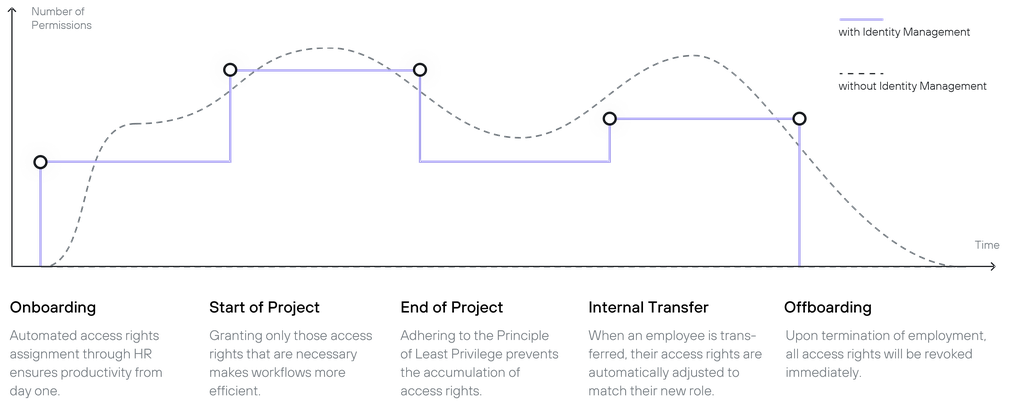
Modern IAM platforms go further by incorporating behavioral analytics. They monitor how users interact with systems over time to spot anomalies. This isn’t about surveillance; it’s about identifying subtle signs that something isn’t right, for example:
A spike in access activity
Unusual login times
Attempts to download large volumes of data
All of these can point to a brewing insider attack in cyber security environments. The goal is not to impose friction, but to create a framework that can scale and adapt to evolving threats while enabling growth and agility within your organization.
Insider Threat Protection with Garancy
To manage the complexity of internal access and mitigate risks posed by insider threats, an IAM software is crucial.
That’s exactly what Garancy delivers. It enables organizations to control and monitor access rights based on individual roles, organizational structure, and evolving business needs. By providing centralized visibility and automated enforcement of access rights, Garancy makes it easier to spot suspicious activity before it becomes a breach.
The platform is designed to adapt to high-change environments, where employees move between roles, teams, and tools frequently. It also supports compliance by maintaining detailed audit logs and access history, an essential requirement for passing security audits and avoiding regulatory pitfalls.
The Takeaway
The most dangerous threats often come from the people and systems we trust the most. Insider threats in cybersecurity are one of the most underestimated risks facing modern organizations. They exploit trust, familiarity, and access, bypassing traditional defenses and leaving lasting damage when not properly addressed. The complexity of today’s digital environments makes it easier than ever for malicious, negligent, or compromised insiders to slip through the cracks.
What’s clear is that static, perimeter-based defenses are no longer enough. Organizations need dynamic, identity-driven solutions to understand, control, and audit internal access on an ongoing basis. This means more than just deploying a new tool – it means adopting a strategic mindset around identity, access, and accountability.
By investing in modern solutions like Garancy, you’re not just preventing insider breaches, you’re building a security culture rooted in transparency, resilience, and trust.
Protect Your Business from Insider Threats
Our IAM experts will show you how effective identity and access management reduces insider risks.