

What Is a Cyber Threat?
A cyber threat is a potential malicious event or activity that could compromise the confidentiality, integrity, or availability of systems and information. Threats may come from external attackers or from within an organization. Insider threats, for example, can involve employees, contractors, or other trusted individuals who intentionally misuse their access or inadvertently compromise security.
It’s important to distinguish threats from vulnerabilities. A vulnerability is a weakness that an attacker may exploit. Many of the risks discussed below are vulnerability categories rather than attack methods in their own right. Understanding both helps organizations identify weaknesses, prioritize security measures, and make informed decisions about protecting their systems and data.
12 Common Cybersecurity Risks Enterprises Should Address
1. Broken Access Control
Having access to a system shouldn’t mean having access to everything inside it. Broken access control occurs when applications fail to enforce restrictions on what authenticated or unauthenticated users are allowed to do. For example, an attacker might manipulate a URL to access another user’s records or exploit missing authorization checks to perform administrative actions.
Organizations should enforce authorization checks on the server side, implement Role-Based Access Control (RBAC) where appropriate, and follow the Principle of Least Privilege. Regular access reviews and automated identity lifecycle processes can help ensure that permissions remain aligned with responsibilities.
2. Cryptographic Failures
Encryption protects sensitive information – but only when implemented correctly. Cryptographic failures can expose passwords, personal information, financial records, and other confidential data. Common weaknesses include outdated cryptographic algorithms, inadequate key management, and missing encryption.
Organizations should use established encryption standards, protect cryptographic keys, and apply appropriate key rotation policies. Transport Layer Security (TLS) helps protect data in transit. Sensitive passwords should be stored using appropriate password-hashing mechanisms rather than reversible encryption.
3. Security Misconfiguration
Sometimes, the problem isn’t a sophisticated attack. It’s a configuration that was never properly secured. Default credentials, unnecessary services, excessive permissions, and exposed administrative interfaces can create avoidable security risks.
Standardized configuration baselines, automated security checks, and regular reviews help organizations identify and correct these weaknesses. Infrastructure as Code and secure deployment processes can also improve consistency across environments.
4. Injection Vulnerabilities
Injection vulnerabilities arise when applications process untrusted input in ways that allow attackers to influence commands or queries. SQL injection is a well-known example. If an application builds database queries using untrusted input without appropriate safeguards, attackers may be able to manipulate those queries.
Prepared statements, parameterized queries, appropriate input validation, and secure coding practices help reduce injection risks.
5. Identification and Authentication Failures
A legitimate username doesn’t guarantee a legitimate login. Weak passwords, reused credentials, inadequate authentication mechanisms, and poorly protected login processes can enable unauthorized access. Credential stuffing is one example: Attackers attempt to use username and password combinations obtained from previous breaches.
Multi-factor authentication (MFA), passkeys as a phishing-resistant alternative to traditional passwords, strong authentication policies, compromised-password checks, and appropriate protection against automated login attempts can significantly reduce these risks.
Authentication confirms identity, authorization determines what that identity may access – both must work together.
6. Software and Data Integrity Failures
Organizations depend on software updates, external libraries, and automated deployment processes. If the integrity of these components cannot be verified, attackers may introduce malicious code or manipulate data without being noticed.
Potential weaknesses include compromised software updates, insecure build pipelines, and insufficient verification of the provenance of third-party components. Such software supply chain attacks exploit trust: the software appears legitimate but was altered on its way to the organization.
Organizations should verify software provenance and integrity, protect development and deployment pipelines, and apply appropriate code-signing and dependency-management controls.
7. Security Logging and Monitoring Failures
Without adequate security logging and monitoring, suspicious activities may go undetected or remain difficult to reconstruct after an incident. Relevant events include failed authentication attempts, privileged account activity, changes to permissions, and unusual access patterns.
Centralized logging, defined alerting processes, and Security Information and Event Management (SIEM) solutions can help security teams detect and investigate suspicious activity. Logs should be protected against unauthorized modification and retained according to applicable requirements.
8. Server-Side Request Forgery (SSRF)
Server-Side Request Forgery occurs when attackers manipulate an application’s server-side functionality to make requests to unintended destinations. Depending on the environment, this may allow interaction with internal services or resources that should not be accessible to the attacker.
Organizations can reduce SSRF risks through strict validation of destinations, appropriate outbound network restrictions, network segmentation, and secure application design.
9. Vulnerable and Outdated Components
Modern applications rely on numerous third-party libraries, frameworks, and dependencies. While point 6 is about whether software has been tampered with, the focus here is on the component itself: It is authentic, but vulnerable.
If it contains known vulnerabilities or is no longer maintained, attackers may exploit weaknesses that already have documented remediation options. Often the problem is not technical: updates are missing, or nobody knows which components are actually in use.
Organizations should maintain an inventory of software components, monitor vulnerability disclosures, prioritize remediation based on risk, and establish reliable update processes. Software Composition Analysis (SCA) can support this work.
10. Insufficient Authorization Logic
A user may be correctly authenticated while still receiving access to functions or information they should not be allowed to use. Insufficient authorization logic occurs when applications make inconsistent or incorrect permission decisions – for example, checking whether someone is logged in without verifying whether they are authorized to approve a transaction.
Authorization rules should be explicit, consistently enforced on the server side, and tested against relevant business scenarios. This category overlaps with broken access control but highlights weaknesses in how authorization decisions are designed and implemented.
11. Business Logic Vulnerabilities
Not every security weakness is caused by a missing technical safeguard. Sometimes, an application works exactly as programmed – but its underlying business rules allow unintended actions. Examples include manipulating transaction sequences, exploiting incomplete approval workflows, or bypassing business restrictions.
These vulnerabilities require more than automated scanning. Developers, quality assurance teams, and business stakeholders need to evaluate how workflows could be misused. Security testing should therefore include realistic business scenarios and potential misuse cases.
12. Insecure Software Development Practices
Security weaknesses can enter an application long before deployment. Insufficient code reviews, missing security requirements, inadequate testing, and poorly managed dependencies can allow vulnerabilities to remain undetected.
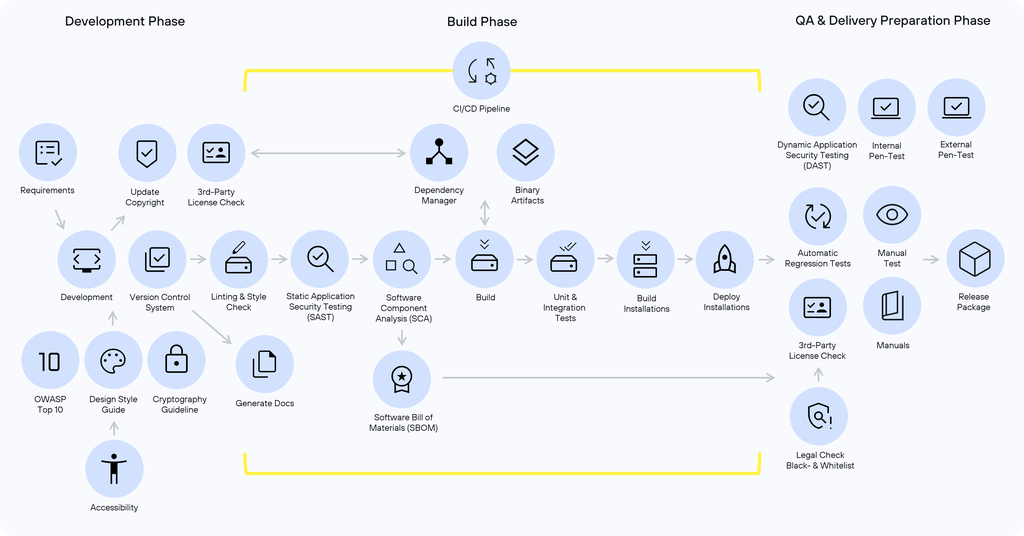
A secure development lifecycle integrates security throughout planning, development, testing, and deployment. Useful practices include:
Secure coding standards and peer reviews
Static Application Security Testing (SAST)
Software Composition Analysis (SCA)
Dynamic security testing and penetration testing
Defined processes for vulnerability remediation
Security should be part of software development from the beginning – not an additional check just before release.
What Identity Management Contributes to Enterprise Security
The twelve risks above require different security measures. Encryption, secure software development, network controls, monitoring, and vulnerability management each address specific weaknesses. Identity & Access Management (IAM) addresses another critical question: Who is allowed to access which systems and data – and why?
A structured IAM approach can help organizations:
Manage identities, roles, and permissions centrally
Automate access provisioning and deprovisioning
Apply role-based permissions and support Least Privilege
Review existing permissions through efficient recertification processes
Improve transparency and traceability across connected systems
These capabilities are particularly relevant to access governance, excessive permissions, and the risks associated with accounts that are no longer required. Garancy supports organizations with centralized identity management, automated lifecycle processes, role and permission management, and recertification workflows.
However, it is important to note that IAM does not replace secure application development, encryption, or threat detection. It complements these measures by helping organizations maintain control over identities and access rights.
Conclusion: Cybersecurity Requires More Than One Line of Defense
Understanding common threats and vulnerabilities is an important starting point. But effective cybersecurity depends on turning that knowledge into consistent processes and appropriate controls.
Secure development practices help reduce application vulnerabilities, monitoring supports the detection of suspicious activity, strong authentication protects access to systems, and structured identity management helps ensure that permissions remain aligned with business responsibilities.
The objective isn’t to eliminate every possible risk. It’s to identify relevant weaknesses, reduce exposure, and respond effectively when security incidents occur.
Questions About Identity & Access Management?
Want to explore how centralized roles, automated access processes, and regular permission reviews could support your security strategy? Our team can help you assess which approach fits your organization and IT environment.